
Comparing Kitchen Renovation Quotes Line by Line: Joinery, Benchtop and the Trades Underneath
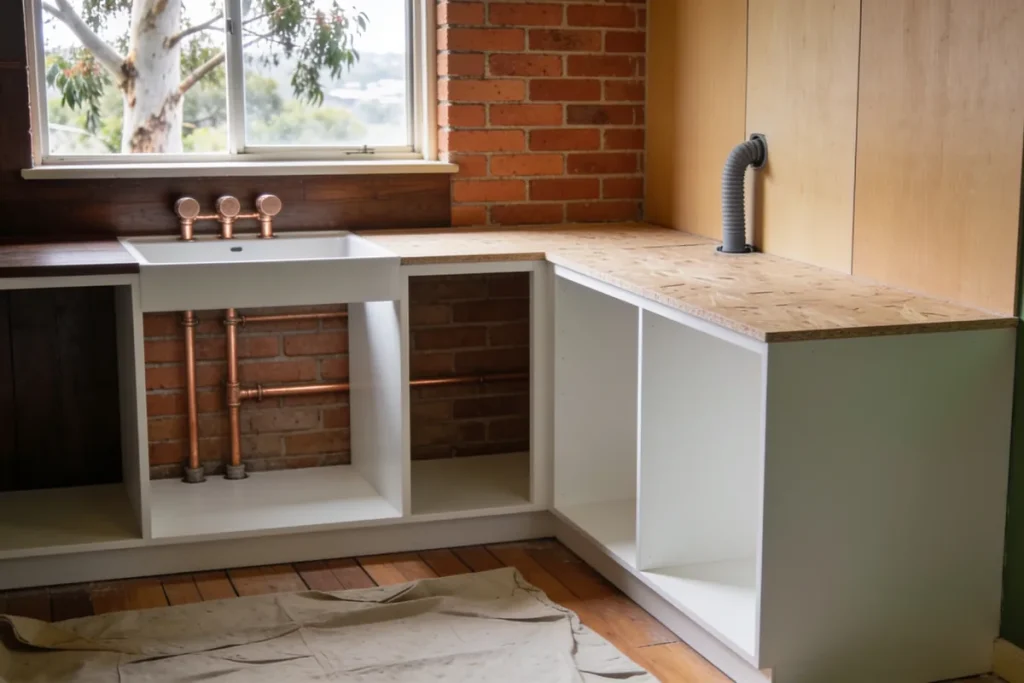
The quotes are stuck to the fridge in a 1970s brick house in Wollongong, three sheets under three magnets, curling a little at the corners from a week of being taken down, read over breakfast and put back. The kitchen they describe is the one the fridge stands in: a galley with a window over the sink, laminate that has started to lift near the kettle, and a cooktop older than the couple who own it. All three companies came out, measured, nodded at the same wall and went away to write it up. One quote came back far higher than the other two, and at first glance it is hard to believe they describe the same room. They mostly do. The difference is in the words. One says “custom joinery”, one says “cabinetry supplied and installed”, one lists a benchtop by brand and thickness while another just says “stone”. None of them is lying, but none of them is easy to lay beside the others either. The sheet below is for doing exactly that, line by line, before anyone looks at the bottom number.
Kitchen quote comparison sheet
Copy each quote's price for each line into its column, and note whether the line is included, left out or only an allowance. The totals add up the numbers you type and nothing else. Leave a cell blank if a quote does not cover that line.
Compare the totals only once the Included column matches across all three.
Flat-pack, semi-custom or custom
The biggest single word on most kitchen quotes is the one describing the cabinets, and it is often the least explained. Three broad kinds turn up, and the names are trade shorthand rather than fixed definitions, so it is worth asking each company what it means by its own.
Flat-pack cabinets are made in standard sizes, packed into boxes and assembled on site, either by you or by an installer the company sends. The carcasses, the boxes behind the doors, are usually a manufactured board with a melamine finish. Because the sizes are fixed, a flat-pack kitchen fills a wall in set widths, and any gap at the end gets a filler panel. Lead times tend to be short, since the parts often already exist.
Semi-custom sits in the middle. The carcasses still come from a manufacturer’s range, but there is more choice in sizes, door styles and finishes, and sometimes a little room to adjust a cabinet to suit an awkward corner. Many kitchen companies work this way, ordering from a supplier and fitting with their own crew.
Custom joinery is built for the room by a cabinetmaker. The dimensions follow the walls rather than a catalogue, the materials are chosen for the job, and the maker usually installs what it made. That takes longer, from the measure to the day the doors go on, and it is one reason a custom quote can sit well above the others.
When you are reading quotes from kitchen and renovation companies, look for three things on this line: what the carcasses are made of, what the doors and drawer fronts are made of and how they are finished, and who assembles and installs them. Two quotes can both say “supply and install cabinets” and mean very different boxes. If the material is not named, ask for it in writing. (Replacing handles and hinges on an existing kitchen is a different job altogether, and not what this sheet is for.)
The benchtop line
The benchtop is where a quote is easiest to read wrongly, because one word can cover a lot of ground. Natural stone, porcelain, laminate, timber and the thin, dense sheets sold as compact surfaces all look like “a benchtop” on paper, and they differ in how they are cut, how heavy they are, how the joins are made and how the edges are finished. A good quote names the material, the thickness, the edge profile and whether the cut-outs for the sink and cooktop are included.
There is also a rule that changed benchtop quotes across the country. Safe Work Australia and the state work health and safety regulators describe a national prohibition on engineered stone that took effect on 1 July 2024. It covers the manufacture, supply, processing and installation of engineered stone benchtops, panels and slabs. So a new kitchen being quoted today should not have an engineered stone benchtop going in.
The prohibition does not reach backwards into existing homes. Engineered stone that is already installed does not have to be removed. If it needs repairing, or if it is coming out as part of a renovation, that work falls under work health and safety rules, and the people doing it need to follow them. If your old benchtop is engineered stone and the quote includes taking it out, it is reasonable to ask how the company will handle that part of the demolition.
If a quote still uses the words “engineered stone” for the new top, ask what it means. It may be an old template that nobody updated. It may be a description of something else. Either way, you want the actual material named before you sign. If a quote names a product you have not heard of, ask what it is made of and whether it can lawfully be supplied and installed.
The trades underneath
The cabinets and the benchtop are what you see. Underneath them sits a stack of other work, and this is where two quotes for the same kitchen most often stop being the same quote.
Plumbing comes first. If the sink stays where it is, the work may be modest: disconnecting, reconnecting and fitting new tapware. If the sink moves, or a dishwasher goes in where there was none, pipes and waste lines move with it. That work has to be done by a licensed plumber. Many kitchen companies subcontract it, and the quote should say who does it. If yours does not, you may end up finding a licensed plumber yourself, and that line belongs on the sheet too, even if it sits outside every quote.
Electrical work follows the same logic. An induction cooktop or a new wall oven may need its own circuit, and the electrician may need to look at whether the switchboard can take it. New power points along the splashback, under-cabinet lighting and a rangehood all add to the list. All of it is licensed work, whatever the price, and the quote should name the electrician or at least say the work is by a licensed electrician.
If there is gas in the kitchen, whether it is being kept, moved or capped, that is work for a licensed gasfitter, and it needs its own line.
Then come the finishing trades. Tiling for a splashback, if it is tiled rather than glass or stone. Plastering and patching where the old cabinets came off the wall, and painting afterwards. And flooring: some kitchens sit on the existing floor, some need new flooring under or around the new cabinets, and some renovations replace the floor across the whole room. If the floor is changing, decide early whether it goes down before or after the cabinets, because that changes what each trade quotes for. The questions to ask about the subfloor before new flooring goes down apply in a kitchen just as much as in a lounge room.
A quote that leaves out the plumber, the electrician and the plasterer only looks cheaper, because somebody still has to pay those trades before you can cook in the room.
Licence and contract thresholds
What a quote must show, and what has to happen before you pay anything, depends on your state and on the size of the job.
In New South Wales, the NSW Government sets out the rules in its guidance on contracts for residential building work. A written contract is needed for work over $5,000 including GST. A small job, between $5,000 and $20,000, can use a small jobs contract. A large job is anything over $20,000, and for those the builder must give you a Home Building Compensation certificate before you pay a deposit. The deposit itself cannot be more than 10 per cent of the contract price. Large jobs also come with a cooling-off period of five clear business days after you sign. The same guidance describes statutory warranties of six years for major defects and two years for other defects.
Before any of that, check the licence. NSW runs an online licence register, and a licence number on a quote takes a minute to look up. Check that the name matches the business you are dealing with and that the licence covers the work being quoted.
In Victoria, Consumer Affairs Victoria explains that most domestic building work over $10,000 needs a major domestic building contract, and the builder must be registered with the Building and Plumbing Commission (BPC).
In other states and territories, the thresholds and the rules are set by the local regulator, and they are not the same as in NSW or Victoria. Look up your own regulator’s guidance before you sign anything, and before you hand over a deposit.
Allowances, PC items and variations
Even with the scope matched line for line, two totals can still mean different things, because part of each one may not be a price at all.
A prime cost item, usually shortened to PC item, is an allowance for something that has not been chosen yet: the oven, the cooktop, the tapware, sometimes the sink. A provisional sum is an allowance for work whose cost cannot be fixed yet, such as plumbing behind a wall nobody has opened. Both are estimates. If the real oven costs more than the allowance, or the plumbing turns out to be more involved than expected, the total moves.
That means a low total can be low because its allowances are low. When you compare, ask each company to list the brand and model of every appliance and every tap they have allowed for. If they have only written a dollar figure, ask what that figure buys. Then put the allowances side by side and see whether you are comparing a basic oven with a better one.
Changes after signing are called variations. You might decide on a different splashback halfway through, or the electrician might find something in the wall. A variation should be agreed in writing, with the change in price shown, before the work is done. A verbal “she’ll be right, we’ll sort it at the end” tends to become the line nobody remembers the same way.
Timeline and the weeks without a kitchen
The couple in Wollongong asked each company the same question: how long will we be without a kitchen? The answers were all different, and the useful part was how each company explained its answer.
Someone has to coordinate the trades. In a full-service kitchen company, it is usually a project manager or the builder. In a job where you have hired the cabinetmaker, the plumber and the electrician separately, it is you. The quote should make clear which arrangement you are paying for.
Ask what happens when one trade runs late. If the benchtop can only be measured once the cabinets are in, and the cabinets arrive a week late, everything after them moves. A good company will tell you which steps depend on which, and roughly how the gaps are handled. Plan for the weeks without a kitchen: where you will cook, where the fridge will go, and how you will wash up.
Reading the sheet
Once the three quotes are on the sheet, resist the bottom line for a little longer. Go down the Included column first. Wherever one quote says “Y” and another says “N” or “allowance”, you have found a gap, and the totals are not yet comparable. Ask the company with the gap to quote that line, or add a fair figure for it yourself.
When you go back with questions, send the same questions to all three companies, in writing, and ask them to answer in writing. It feels a little formal for a kitchen, but it means the answers arrive in a shape you can copy straight onto the sheet, and nobody is working from a different version of the conversation. The couple in Wollongong found that one of their questions, about who was taking away the old cabinets, changed two of the three quotes on its own.
Check the last two rows as well. A quote from someone whose licence you could not find, or whose contract asks for more than the deposit limit, needs another conversation before it stays on the fridge.
Only when the Included column matches across all three do the totals mean what they appear to mean. Sometimes the cheapest quote stays the cheapest. Sometimes the gap between them shrinks to almost nothing once the plumbing and the plastering are in.
Make Them Comparable, Then Choose
Three quotes for one kitchen are three descriptions of the same job, written by people who each want the work. Translate them into the same lines, ask for the missing parts in writing, check the licence and the contract rules for your state, and then compare the totals. The price still matters, but by then you know what it is buying. In the Wollongong kitchen, the three sheets came off the fridge and went into a folder, with one filled-in comparison clipped to the front. The choice they made from it was theirs, and they could explain every line of it.
Sources: NSW Government, Contracts for residential building work, 2026 (https://www.nsw.gov.au/housing-and-construction/building-or-renovating-a-home/preparing/contracts); Consumer Affairs Victoria, Laws about home building contracts (https://www.consumer.vic.gov.au/licensing-and-registration/builders-and-tradespeople/running-your-business/domestic-building-contracts/laws-about-home-building-contracts); Safe Work Australia, Engineered stone ban (https://www.safeworkaustralia.gov.au/safety-topic/hazards/silica/engineered-stone-ban)