
How Big a Storage Unit Do You Need? Work It Out From What You Own
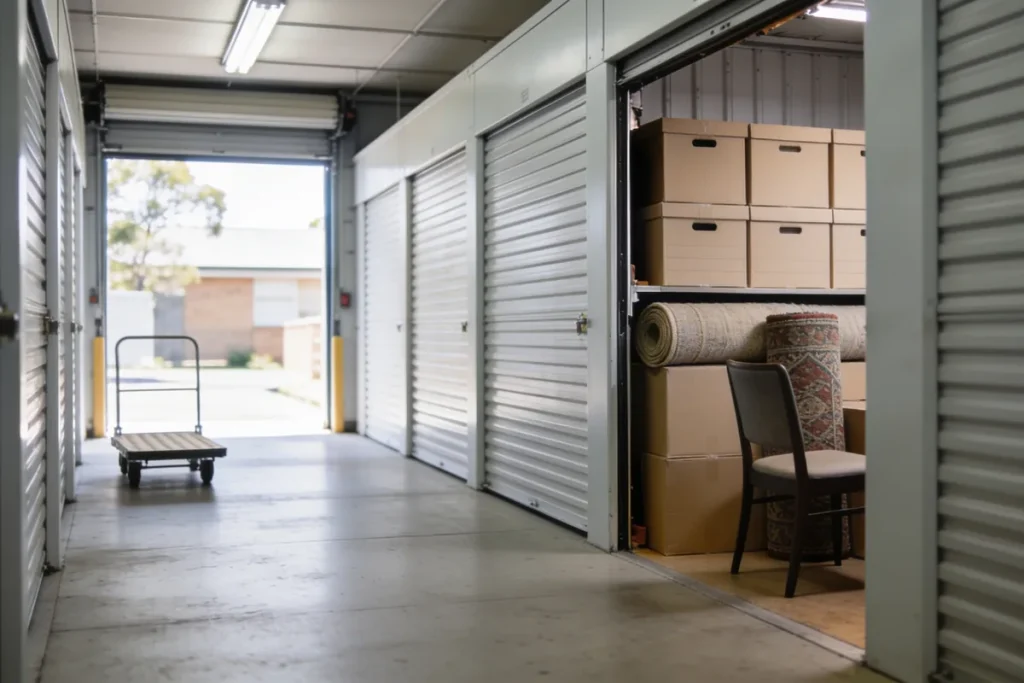
The size chart on a storage facility’s website usually describes units in terms of homes: a “studio”, a “one-bedroom apartment”, a “two-bedroom house”. It is a friendly way to sell space and a poor way to measure it. Your two-bedroom house might hold a piano, a spare fridge in the garage and forty boxes of books, while your neighbour’s holds a bed, a couch and a television. The labels guess at an average household, and you are not an average household. If you are clearing rooms while new floors go down or between houses, the better method is to count what you own and work out the floor area from that. The calculator below does the arithmetic.
Storage unit size estimate
An estimate from what you own. It uses rough working figures per item (not an industry standard), so ask to see the unit before you sign.
Count your boxes, large furniture, whitegoods and long or bulky items, then work out the floor area each group needs.
Enter what you plan to store to see an estimate.
Estimate only. Sizes vary by facility.
Floor area is not the whole story
Storage units are sold by their floor footprint. Kennards Self Storage, to take one operator, lists sizes starting from a 1.5 x 1.5 m unit it calls a “large closet”, describes its sizes as approximate, and states a minimum height of 2.4 m.
The footprint is the number on the price list, but it is only one of three numbers that decide whether your things fit. The second is height: how high you can stack safely. A unit 2.4 m tall holds a great deal more if your boxes go up to the ceiling than if they stop at shoulder height. The third is access: whether you need an aisle so you can reach things during the term. An aisle costs floor space that holds nothing.
Think of it as a spreadsheet with three inputs. Footprint times usable height gives you volume, and the aisle takes some of that volume back. Two people renting the same 3 x 3 m unit can end up with very different amounts of usable space, depending on how they stack it and whether they leave a path down the middle.
That is what the calculator models. It works on floor area, because floor area is how units are priced, but it adjusts for stacking height and for an aisle.
Measure what you own
Start by sorting your belongings into groups. Each group behaves differently once it is in a unit.
Large furniture. Beds, sofas, wardrobes, dining tables. These take the most floor space and usually cannot be stacked. Mattresses and table tops can stand on edge against a wall, which saves a surprising amount of floor.
Whitegoods. Fridges, washing machines, dryers. They stand upright and take a fixed footprint each.
Boxes. Standard moving boxes stack, which makes them the most space-efficient items you own. Their footprint shrinks with every layer you can add.
Long or bulky items. Bikes, ladders, mowers, surfboards. Awkward shapes that waste space if they are not planned for.
Fragile items. Mirrors, artwork, glassware. These need to go on top or to the side, never under anything heavy.
Two practical rules sit on top of the counting. Leave an aisle if you think you will need anything before the term ends, and do not stack heavy items over fragile ones, however tight the space gets.
A note on the numbers inside the calculator. It uses working assumptions for each type of item: about 0.25 square metres of floor per box, about 2 square metres per large furniture piece, about 0.6 square metres per whitegood and about 0.8 square metres per long item. These are deliberately conservative round figures chosen for this tool. They are not an industry standard, and your own items will vary, so treat the result as an estimate and a starting point.
A worked example shows how it fits together. Say you have 30 boxes, three large pieces of furniture, two whitegoods and two bikes, and you can stack to 2.4 m. The boxes stack six high, so they need about 1.25 square metres of floor. The furniture needs about 6, the whitegoods about 1.2 and the bikes about 1.6. That totals a little over 10 square metres. Add 20% for an aisle and it comes to about 12 square metres, which rounds up to a 3 x 4.5 m unit. Without the aisle, the same goods would round up to the same size, with less room to spare.
A second, smaller example shows the height input at work. Say you are storing 40 boxes and nothing else. Laid out in a single layer, at 0.25 square metres each, they would need 10 square metres of floor. If you are only comfortable stacking to 1.8 m, which is four layers, that drops to 2.5 square metres and calls for a 1.5 x 3 m unit. Stack six high at 2.4 m and it drops to about 1.7, which fits in a 1.5 x 1.5 m unit. Adding the 20% aisle to the four-layer version takes it to 3 square metres, still inside 1.5 x 3 m. On a load made only of boxes, stacking height is the input that decides the unit size.
Access, security and climate
Once you have an estimate of size, the next questions are about how you will use the unit.
Access hours. When can you get in, and is there a fee for after-hours access? If you work long days, a facility that closes at five may not suit you. Twenty-four-hour access is not a given, so if you expect to visit early or late, confirm the hours in writing rather than relying on the website.
Drive-up or upstairs. A ground-floor unit you can back a trailer up to is a very different job from an upstairs unit reached by a lift. Check the lift’s size if you are storing large furniture.
Keys and security. Who holds the keys or codes? Is there CCTV, and do individual units have alarms?
Climate. Timber furniture, paper documents and electronics may be better off in a climate-controlled unit. Ask whether the facility offers one and what it controls.
If you are comparing facilities in your area, the directory’s transportation and warehousing listings include storage businesses you can put these questions to.
Insurance: is it covered at all
Ask the facility whether it requires you to take out its own insurance, or whether it accepts cover from your existing contents policy. Then check your home contents policy to see whether it covers goods stored away from home, and on what terms. It is far easier to find that out before you move anything in than after something goes missing.
Two questions come up again and again here: is storage insurance mandatory, and is it worth it? The first depends on the facility and its contract, which is why you ask. The second is a sum you can do yourself. Take the list you made for the calculator, put a rough replacement value next to each group, and total it. Then compare that with what your existing contents policy would pay for goods stored away from home, if it covers them at all. The gap between those two numbers is what you are deciding whether to insure. Keep the list and some photos of the packed unit too. If you ever need to make a claim, an inventory written before anything went wrong is far more useful than one pieced together afterwards.
The contract terms that cost more than a wrong size
Choosing a unit one size too big costs you the difference in rent. Signing a contract you have not read can cost a lot more. In spreadsheet terms, the monthly price is one cell. The clauses are the formula that decides what that cell turns into over a year.
Here is what to look for:
- Price rises. How much notice does the facility give before a price increase, and can you leave without penalty if you do not accept it?
- Notice to vacate. How many days’ notice do you need to give when you want to move out?
- Minimum terms and specials. A first-month special can be generous. Check what the price reverts to, and whether you are locked in for a minimum period.
- Late fees and default. What happens if you fall behind on payments? When do you lose access to the unit? And at what point can the operator sell your goods? State storage laws and the contract itself set this, so read the notice period in your own contract carefully.
Readers often ask whether they can cancel a storage unit at any time. It depends on the contract, and specifically on two clauses: the minimum term and the notice to vacate. Find both and you have the answer for your unit. A contract with no minimum term but a long notice period still ties you in for that period, so put the notice in your calendar as soon as you know your move-out date.
There is also some protection on your side. The ACCC has explained that, from 9 November 2023, unfair contract terms in standard form consumer contracts are prohibited and can attract penalties. That applies to contracts made, renewed or varied on or after that date. If a term in your storage agreement looks one-sided, ask about it before you sign. And separately, the ACCC notes that consumer guarantees apply to services, and a business cannot remove them.
Moving the goods in
You have two broad options for getting everything to the unit. Some removalists also offer storage, or will move goods straight into a unit you have rented. Alternatively, a hired trailer or van works well for smaller loads.
Either way, a little planning helps on the day. If your unit is upstairs, book the lift if the facility asks you to. And pack the unit back to front by what you will need first: the things you are least likely to need go in the back, and anything you might want during the term goes near the door.
Keep a copy of your list with you on the day. Ticking items off as they go in tells you whether the estimate held, and if the unit fills faster than the calculator said, you will know before the last load rather than after.
Measure Twice, Rent Once
The labels on a size chart describe someone else’s home. Count your own things instead: furniture, whitegoods, boxes and long items. Run them through the calculator with your real stacking height, add an aisle if you will need access, and use the result as an estimate. Ask to see the unit before you sign. Then read the contract as carefully as you measured, particularly the clauses on price rises, notice and late fees, because those decide what the unit really costs.
Sources: Kennards Self Storage, Storage unit size guide (https://www.kss.com.au/help-centre/benefits/unit-size-guide); ACCC, Businesses urged to remove unfair contract terms ahead of law changes, 2023 (https://www.accc.gov.au/media-release/businesses-urged-to-remove-unfair-contract-terms-ahead-of-law-changes); ACCC, Consumer rights and guarantees (https://www.accc.gov.au/consumers/buying-products-and-services/consumer-rights-and-guarantees)