
Plantation Shutter Quotes: Why the Same Window Prices So Differently
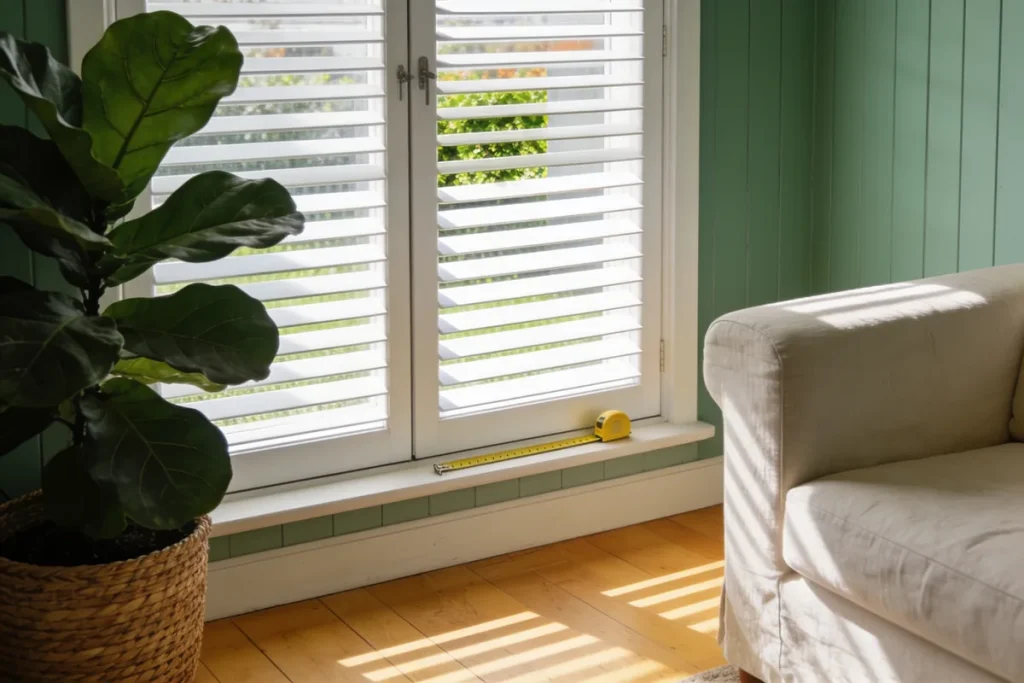
Three quotes, one window
You asked three businesses to quote plantation shutters for the same bedroom window, and the three numbers do not line up. One quote is a single line with a total at the bottom. One runs to a page and a half. The third came by email the night after the measure-up and mentions a timber you have never heard of.
The easy moves are to circle the cheapest figure, or to assume the dearest must be the best. Both throw away information you already have. When I lay quotes side by side, most of the gap usually comes from what each business priced, and much less from who priced it. A different material, a different frame, an extra panel, installation included on one and missing from another. Put those in rows and the spread tends to shrink to something you can actually judge.
So this is a guide to why plantation shutters cost what they do, and how to read each cost driver off the paper in front of you. It contains no prices, on purpose. The only published ranges I could find come from marketplace cost guides, they disagree with one another, and neither shows its working. A number like that anchors you to somebody else’s window. Your three quotes are better data than any average.
The material line
Material is the first row I fill in, partly because so much of the rest of the quote hangs off it and partly because quotes are often vague about it. Most suppliers work with three families.
PVC. Sometimes sold as polymer or vinyl. It copes well with moisture, which is why it tends to be offered for bathrooms, laundries and kitchens, where steam and splashes are part of the day. It comes in painted-look finishes. If you want visible grain, this is the wrong family.
Timber. The only one of the three you can stain so the grain shows through, and it can be painted as well. Timber is also where quotes differ most quietly, because the word covers several species, and they differ in weight, stability and cost. “Timber shutters” on a quote tells you the category and leaves out the part you are actually paying for.
Aluminium. Usually the choice for outdoor and alfresco openings, where the shutters will meet weather that would trouble the other two. Suppliers also reach for it on large openings.
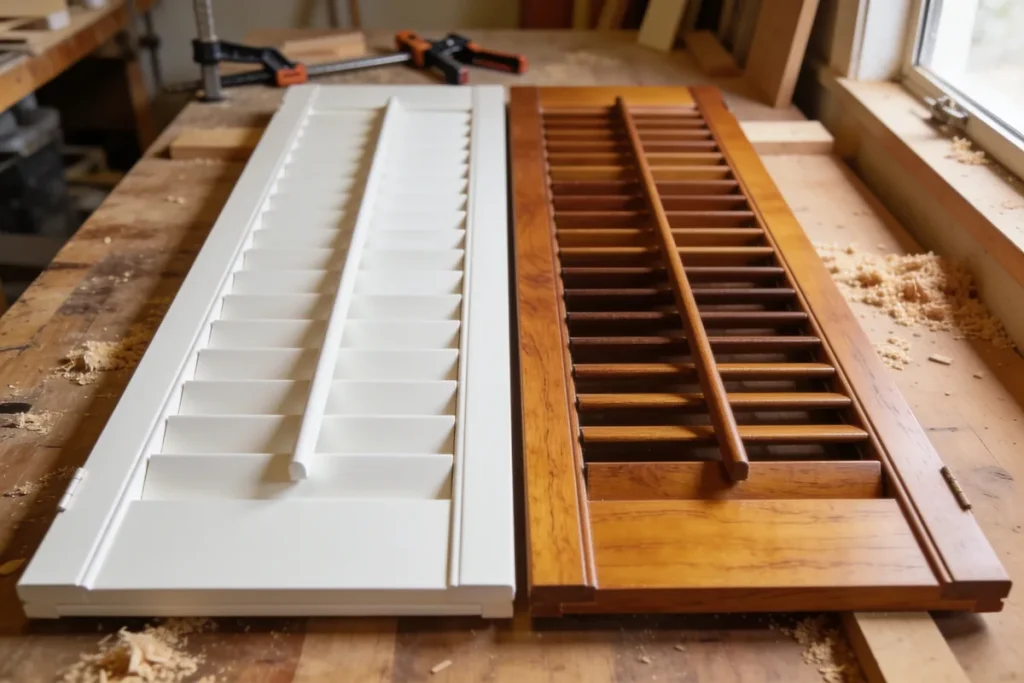
Two practical points follow. First, a quote that does not name the material is not comparable with one that does, and a timber quote that does not name the species is only half comparable. Ask, and get the answer written on the quote. Second, finish is its own variable. A painted timber shutter and a stained one can be priced differently by the same supplier, so check that all three quotes assume the same finish before you compare the totals.
It also helps to decide the material room by room before you collect quotes. A house can reasonably end up with PVC in the bathroom and timber in the living areas. If one supplier quoted the whole house in a single material and another split it, you are looking at two different jobs.
Who measured, and how
The second thing I check is who did the measuring. Some businesses send someone out for a free measure-up. Others will quote from measurements you take yourself, often through an online form.
A self-measure quote can look cheaper, and part of the reason is that the risk has moved to you. Shutters are made to fit one opening, so an error in your tape work becomes your problem when the panels arrive. A measure-up quote prices in a person who is responsible for the numbers. Before you compare the two, ask the self-measure supplier what happens if your measurements turn out wrong.
A good measure-up also picks up the things that move the price. Older houses rarely have perfectly square window reveals, and an installer has to allow for that or the panels will sit with uneven gaps. The frame type will show up on the quote too, usually as one of these:
- L-frame, a frame with a lip, often used where the shutter sits inside the reveal.
- Z-frame, a stepped profile that can sit over an architrave or cover gaps around the opening.
- Direct mount, where the hinges fix to the existing window frame or reveal with no separate shutter frame.
Different frames suit different windows, and they are priced differently. If quote A says Z-frame and quote B says direct mount, they are describing two different installations.
Then there is shape. Arches, angled tops, corner windows and other non-rectangular openings are where custom work costs more, because they take more measuring, more making and more fitting time. If your house has one of these, check that every quote has priced that window on its own rather than averaging it in with the plain ones.
Panels, blades and hardware
Once material and frame are settled, the quote should describe how the shutter actually works. This is where single-line quotes leave the most out.
Panels can be hinged, which is the common setup on windows. They can also be bifold, sliding on a track, or fixed in place. Sliding and bifold panels on tracks are typical across doors and wide openings, and the track is extra hardware that someone has to supply and fit. A quote with tracks and one without are pricing two different products.
Blade width changes both the look and the view, and suppliers offer more than one size. The tilt rod is another variable: a front tilt rod runs down the face of the panel, while a hidden one tucks the mechanism away at the edge. Different layouts can mean a different number of panels across the same opening, and each panel takes material and labour.
Ask each supplier which blade width, tilt rod and panel layout they quoted for each window, and have it written down. You do not need to know which option is best before you ask. You need to know that all three quotes describe the same thing.
What is in the installation line
The installation line is often the shortest on the page and the one that hides the most. Read it for what it leaves out as much as for what it says.
Is fitting included in the total, or priced separately? Does the quote cover taking down the existing blinds or curtains, and what happens to them? If old fixings leave holes or marks, who makes good, and is that in the price? These are small items on their own. Across a whole house, they add up.
Then there is timing. Custom shutters are made to order, so there is a lead time between signing and fitting. A quote that states it lets you plan around it. A quote that does not leaves you guessing. The payment terms belong here too: how much deposit is asked for at signing, and when the balance falls due, whether at delivery, at installation, or once the job is signed off. Two quotes with the same total and different payment terms are not quite the same offer.
The warranty is a separate promise
Most shutter quotes mention a warranty, and they are worth reading closely, because a warranty sits on top of rights you already have.
The ACCC explains that consumer guarantees apply automatically when you buy products and services in Australia, and that a warranty is an extra promise a business makes on top of them. In spreadsheet terms, the guarantees are the baseline row and the warranty is whatever the supplier chooses to add above it.
So the useful questions are about scope and length. What does the warranty cover: the frame, the hinges, the finish, the installation, or only some of these? How long does each part last? Is a finish that yellows or peels covered, or only a structural fault? Get the answers in writing on the quote or in the terms attached to it. A warranty you heard about at the measure-up and cannot find on paper is hard to rely on later.
Shutters against blinds, on two points
Plantation shutters are often weighed against blinds, and price usually drives that decision. Two other points deserve a row in the comparison.
Cords. The ACCC administers a mandatory safety standard for corded internal window coverings, which covers curtains and blinds that have a cord, along with their fittings. It sets installation rules, including that a loose loop of cord 220mm or longer must not sit less than 1,600mm above the floor, and it carries a labelling requirement for installers. Plantation shutters operate with no cord at all. In a child’s bedroom or a room where a cot sits near a window, that is a practical difference worth weighing, separate from anything on the price line.
Heat. Your Home, the Australian Government’s guide to sustainable housing, says up to 40% of a home’s heating energy can be lost through its windows. That figure is about windows in general and says nothing about what any particular covering will save. Read it as background: windows are a big part of where winter heat goes, so a covering that fits the opening well earns its place. If a supplier quotes you a performance figure for their shutters, ask where it comes from.
A side-by-side table
This is the table I would use. Fill it in with the three quotes in front of you, one column each. Any cell you cannot fill is a question to send back to that supplier before you sign anything.
| What to check | Quote A | Quote B | Quote C |
|---|---|---|---|
| Material and timber species | |||
| Measured by (supplier or self) | |||
| Frame type | |||
| Panel layout (hinged, bifold, sliding, fixed) | |||
| Blade width and tilt rod | |||
| Installation and removal of old coverings | |||
| Lead time | |||
| Deposit and balance terms | |||
| Warranty: what is covered, and for how long |
Once every row is full, compare the totals again. Often the spread looks smaller, or at least explainable, and the reasons for it are written in your own handwriting.
The Quote Worth Signing
Price on its own will not pick the winner for you. The quote I would sign is the one where you can name the material, the frame, the panel layout and the hardware, where installation and removal are spelled out, where the timing and payment terms are clear, and where the warranty is written down with its scope and length.
If one supplier fills every row of the table and another leaves half of it blank, that tells you something before you even look at the totals. Send the gaps back as questions. How clearly a business answers them is about the best early read you will get on how it handles the rest of the job.
Sources: ACCC, Consumer rights and guarantees, 2026 (https://www.accc.gov.au/consumers/buying-products-and-services/consumer-rights-and-guarantees); ACCC Product Safety Australia, Blinds, curtains and window fittings mandatory standard (https://www.productsafety.gov.au/standards/blinds-curtains-and-window-fittings); Your Home, Glazing, Australian Government (https://www.yourhome.gov.au/passive-design/glazing)