
The Cheaper Lawn Mowing Quote Can Cost More Over a Year
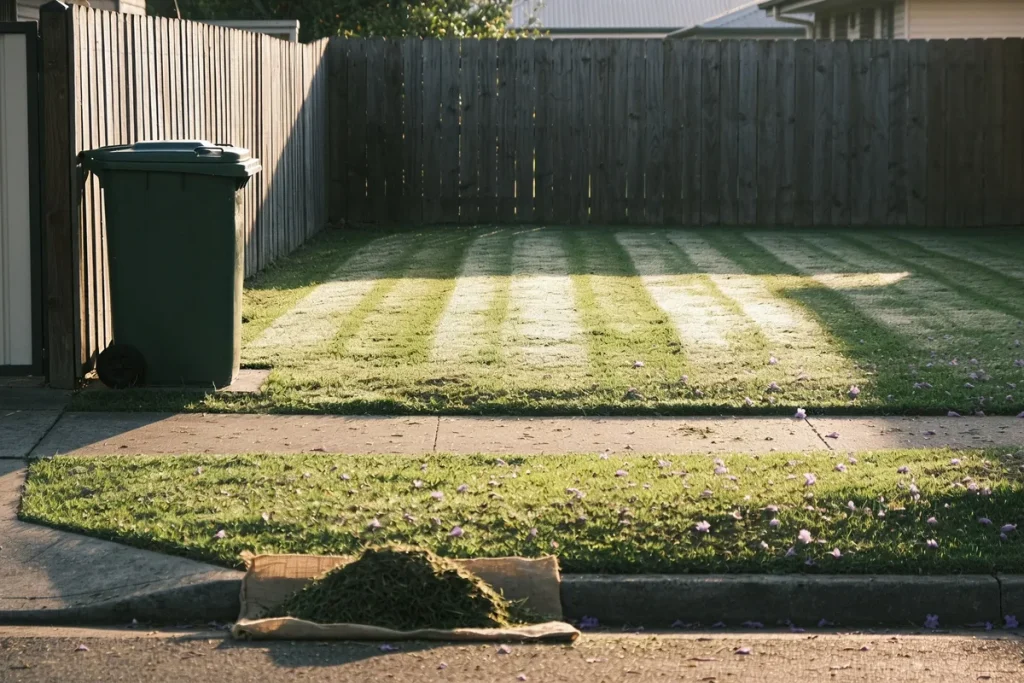
Say two quotes arrive for the same suburban lawn. One is $100 a visit and says green waste included. The other is $85 a visit and says green waste extra. Fifteen dollars separates them on the page, which reads as $390 across a year of 26 fortnightly visits. The gap does not stay that size.
The second quote leaves the disposal cost outside the number, and disposal is the part of a mowing job that varies most. Mulch the clippings and the visit costs nothing extra. Put them in the household green bin and the cost is a bin charge spread across the year. Take them to the tip and a gate fee lands on every load. On the published fees below, the $85 quote can finish $301.60 above the $100 one, or $44.20 below it, depending on how often the trailer is emptied.
That is the argument for pricing a lawn by area and frequency, with the green waste method named in writing. The headline rate is not the annual cost.
What the price guides agree on
Published Australian price guides disagree on plenty, but they agree on the shape of a lawn mowing price. You pay per visit, by the size of the lawn, and the figure sits in a band rather than on a single number. The typical figures in the 2026 What’s The Damage guide are $60 for a small lawn up to 100 square metres, $100 for a medium lawn of 100 to 250, $140 for a large one of 250 to 500, and $200 for anything over 500. The bands run from $45 to $100 at the small end and $140 to $350 at the top.
City starting prices are $41 in Adelaide, $45 in Brisbane and Sydney, and $47 in Melbourne and Perth. Those are entry points, not averages, and a steep block can move any of them.
Two other units appear in the guides. Hourly rates run $45 to $100, and per-square-metre rates run $0.05 to $0.15. Both are secondary.
The fixed-price list is the useful cross-check. QuickMow, an online booking operator, publishes $89 for a lawn up to 400 square metres, $115 up to 600 and $149 up to 800, GST included, with clippings mulched. Removal is a paid option chosen at booking, and the fee is not published on the page.
That detail is the pattern. The guides treat green waste as a sentence rather than a line in the quote. Removal appears as a possibility and stays out of the arithmetic. Browsing the lawn mowing services listed near you shows the same split. Operators describe what a standard visit includes, and disposal is usually a line to confirm rather than a number to read.
QuickMow’s small lawn runs to 400 square metres while the guide’s small stops at 100, so a “small lawn” quote without a measurement compares with neither.
The hour is the wrong unit
The hourly rate starts arguments for a structural reason. An hourly quote pays the operator for time, which means it pays for slowness. The same lawn can take 25 minutes with a ride-on or 70 with a push mower, and the customer cannot tell which is coming. The guides lead with a per-visit price by area because the market prices the job, not the hour.
Frequency changes the rate more than anything else in the quote. The same guide prices a fortnightly maintenance plan for a medium lawn at a typical $75 a visit, against $100 for a one-off. Regular work is faster and the clippings are lighter. A one-off rescue mow on long grass is priced for the harder job it is.
The overheads argument is real. Insurance, GST, travel and tip fees sit inside a per-visit rate, and a franchise with staff and trucks carries more of them than a sole operator with a ute. Overheads explain the level. They do not explain a quote that hides the disposal line.
The unit is also behind the common complaint about a flat fee that becomes an hourly rate once work starts. Online, the suspicion is that the unit changes when the bill needs to grow. The fair version of that concern is simple: name the unit before work starts and stay with it. If the job is genuinely bigger than the quote assumed, the honest move is a revised quote agreed before the mower comes off the trailer, not a clock in the front yard.
Before comparing two quotes, measure the lawn and count the edges. Scope explains why the same window gets three different prices in the shutter trade. The gap is usually in what each business included, not in what each charged.
The green waste line, three ways
A mowing quote can deal with clippings in three ways, and each has a different cost structure.
Mulched. The clippings stay on the lawn, cut fine by the mower. It is the default in most fixed-price services, including QuickMow’s, and adds nothing to the visit. A long, wet first cut can leave rows that need raking, so the method rewards frequency.
The client’s green bin. The operator empties the catcher into the household bin. The marginal cost looks like zero because the bin is already paid for, but the charge is real once spread across the year. Brimbank City Council’s annual food and garden organics charge, updated 15 October 2026, is $115.49 for a 240 litre bin or $103.30 for 140 litres. Spread over 26 visits, the 240 litre bin adds $4.44 a visit. Capacity is the constraint: a 240 litre bin holds a limited volume of grass, and a large lawn in spring can fill it in one cut.
The tip run. The operator loads the clippings and pays the gate fee. This is where quotes diverge most, because the fee is set by the facility, not the mower. Under Brisbane City Council’s resource recovery schedule, current in November 2026, green waste costs $16 for a load up to 100 kilograms, $26.60 for 100 to 500 kilograms and $131 a tonne above that, for vehicles and trailers under 4.5 tonnes. A car or station wagon with green waste up to 500 kilograms pays $16.
Tamala Park, run by the Mindarie Regional Council, shows how far the numbers travel. Its 2026/27 schedule carries a $29.15 minimum for up to 100 kilograms and $291.50 a tonne for green waste. A 200 kilogram load costs $58.30 there, more than double Brisbane’s $26.60 for a load of up to 500 kilograms.
One more trap: Brisbane households get 10 free waste vouchers a year covering up to 1,000 kilograms. The vouchers attach to the household, not to the business. They are not an input a mowing operator can use, and a quote that promises free disposal is quietly assuming someone else’s entitlement.
The arithmetic uses 26 fortnightly visits and the typical mow price for each lawn size. The bin column adds $4.44 a visit. The tip column adds Brisbane’s $26.60 for a load of 100 to 500 kilograms.
| Lawn | Mulched | Own bin | Tip each visit |
|---|---|---|---|
| Small, to 100 sqm | $60 / $1,560 | $64.44 / $1,675 | $86.60 / $2,252 |
| Medium, 100-250 | $100 / $2,600 | $104.44 / $2,715 | $126.60 / $3,292 |
| Large, 250-500 | $140 / $3,640 | $144.44 / $3,755 | $166.60 / $4,332 |
| XL, 500+ | $200 / $5,200 | $204.44 / $5,315 | $226.60 / $5,892 |
Each cell shows the per-visit and per-year figure. The table is our arithmetic from published inputs, not a market average. Annual bin and tip figures are rounded.
Disposal changes with method, not with the mower’s skill. The XL lawn pays $5,200 for the mowing year and $5,892 if every cut goes to the tip. The mowing is identical. The waste line is not. If hedging or pruning joins the job, garden care and maintenance businesses usually quote green waste as a separate line.
Two quotes, one lawn, one year
Take a hypothetical household with a medium lawn, 100 to 250 square metres, mown fortnightly. That is 26 visits a year. Two quotes land.
Quote A is $100 a visit with green waste included. The year costs 26 x $100, or $2,600.
Quote B is $85 a visit with green waste extra. The mowing costs 26 x $85, or $2,210. The tip fee is passed through at cost, $26.60 a load, and the trailer holds two cuts. If it is emptied after every visit, the year carries 26 loads at $691.60, and the total is $2,901.60. Quote A is ahead by $301.60.
Now change one habit. If the trailer is emptied every second visit, the year carries 13 loads at $345.80. Quote B totals $2,555.80 and is $44.20 cheaper than Quote A.
The tipping point is findable. The two quotes sit $15 apart a visit, which is $390 across the year. Divide that headroom by the $26.60 gate fee and you get 14.66. Quote B stays cheaper while it makes fewer than about 15 tip runs a year, which is roughly one every second visit. At 26 tip runs it loses, and at 13 it wins narrowly.
Location can move the answer further than frequency does. At Tamala Park’s $291.50 a tonne, a 200 kilogram load costs $58.30. Twenty-six of those cost $1,515.80, and Quote B finishes at $3,725.80, which is $1,125.80 above Quote A. Even a light load paying the $29.15 minimum 26 times adds $757.90 to the year.
None of this makes the $85 quote a trick. The quote only becomes comparable when the waste method and the tip frequency are on the page.
The clauses that move the bill
Six clauses move the annual total after the rate is agreed.
The first cut. Long grass is a harder job, and most operators price the first visit above the regular rate. Ask for that figure separately, then ask what the regular rate becomes once the lawn is back in shape.
Wet weeks. A skipped visit does not disappear. The next cut is longer, heavier and slower, and some operators charge more for it or compress the schedule to catch up. Agree what happens when a visit is rained off, including whether the fee moves.
The trailer minimum. A tip run has a floor. Brisbane charges $16 for a load up to 100 kilograms, and Tamala Park’s minimum is $29.15. A light load still pays the minimum, which is why small, frequent tip runs cost more per kilogram than a full trailer.
Edging. The guides put edging and trimming at $20 to $50 as an add-on, and some operators include it. The question is whether it is inside the rate. “Edges trimmed” in a service description is not the same as edging in the quote.
Bin access. If the operator uses your green bin, it needs to be accessible and empty on the day. A full bin sends the clippings to the tip, and the tip fee lands back on the quote.
Contamination. A load with plastic, soil or stones can be rejected or charged differently. Ask who pays if that happens, and what the operator does to keep lawn clippings separate from other green waste. The answer says how carefully the job is run.
What to ask before you sign
Start with the document itself. An estimate is an approximate cost given before a firm quote and can change. A quote is a total amount that forms a binding contract when it is accepted. Consumer Protection WA draws the distinction in those terms, and while the wording is Western Australian, the practical test is worth using anywhere: if the paper says estimate, the number can move.
A written quote should carry contact details, ABN and licence number where one applies, the job description, materials, labour, time, any call-out fee, weekend rates, possible extra work and the terms. If a call-out fee is not in the quote, Consumer Protection WA’s guidance says you do not have to pay it.
Put these questions to every operator on the shortlist:
- Is the green waste method named in writing: mulched, my bin or a tip run?
- If it is a tip run, is the gate fee included in the visit rate or passed through, and at what rate?
- How often is the trailer emptied?
- What is the first-cut price, separately from the regular rate?
- What happens to the fee if a visit is skipped or rained off?
- Is edging included?
- Are you insured, and what is your ABN?
A written quote that answers those questions can be set beside another one. A verbal rate cannot, however friendly the operator. A very low quote sometimes carries no insurance, and that saving looks smaller if something goes wrong on your property.
Where the Quote Meets the Tip
A cheap headline rate can still produce the dearest year. A $15 gap a visit is real money, but it is smaller than the disposal line can move in either direction, and the disposal line is the one most quotes leave blank.
So price the job by area and frequency, and make the waste method a written term: mulched, your bin, or a tip run at a named rate. Then compare annual totals. A slightly dearer all-in quote can still produce the cheaper year, and an $85 quote can still win if the trailer is emptied every second visit. Both outcomes come from the same arithmetic.
Read the waste line first. The rest of the quote is easier to judge once you know what happens to the clippings.
Sources: What’s The Damage, Lawn Mowing Cost Australia 2026 (https://whatsthedamage.com.au/lawn-mowing-cost/); QuickMow, lawn mowing prices (https://quickmow.com.au); Brisbane City Council, Resource recovery centres (https://www.brisbane.qld.gov.au/bins-waste-and-recycling/waste-and-recycling-facilities/resource-recovery-centres); Mindarie Regional Council, Tamala Park fees and charges (https://www.mrc.wa.gov.au/tamala-park/disposal/fees-charges.aspx); Brimbank City Council, Food and garden organics bin (https://www.brimbank.vic.gov.au/living-here/my-home/rubbish-recycling-and-other-waste/bins/food-and-garden-organics-bin); Consumer Protection WA, Estimates, quotes and deposits (https://www.consumerprotection.wa.gov.au/estimates-quotes-and-deposits)